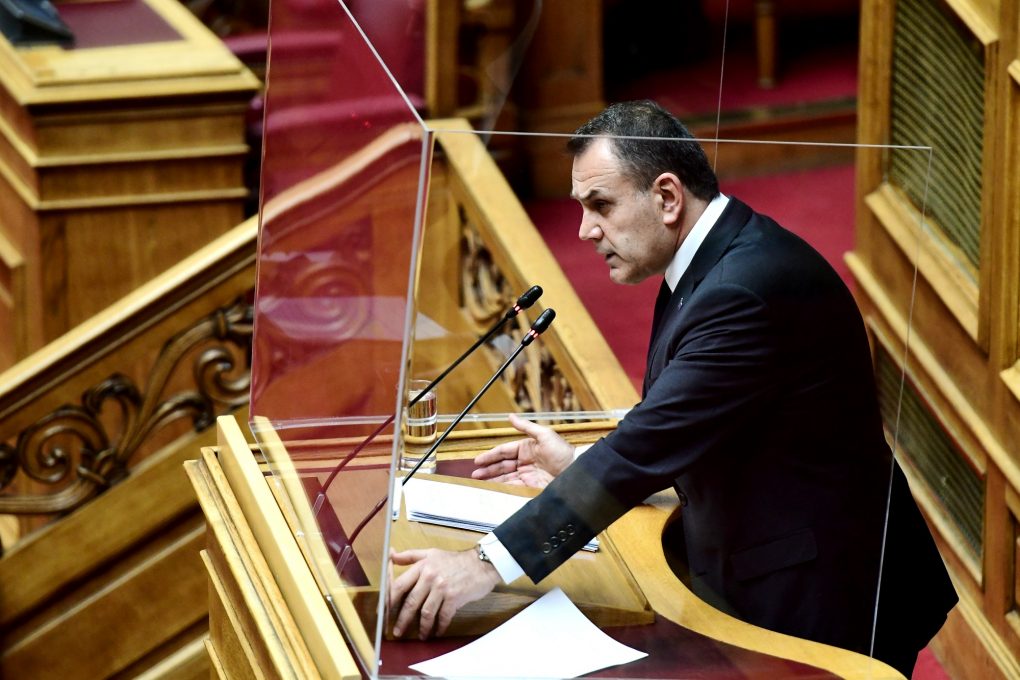
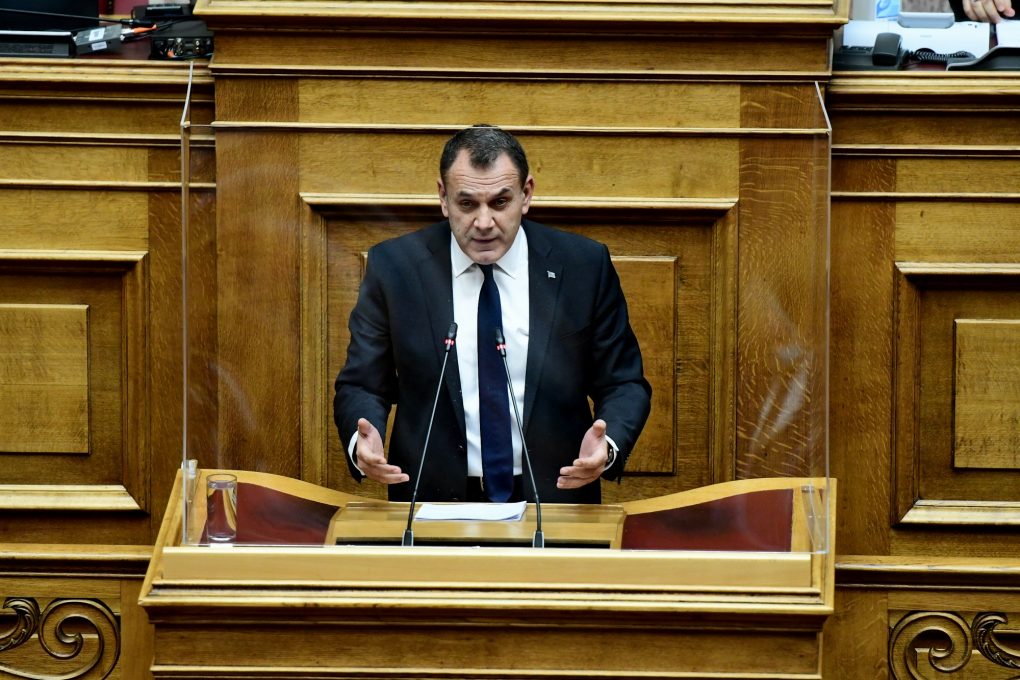
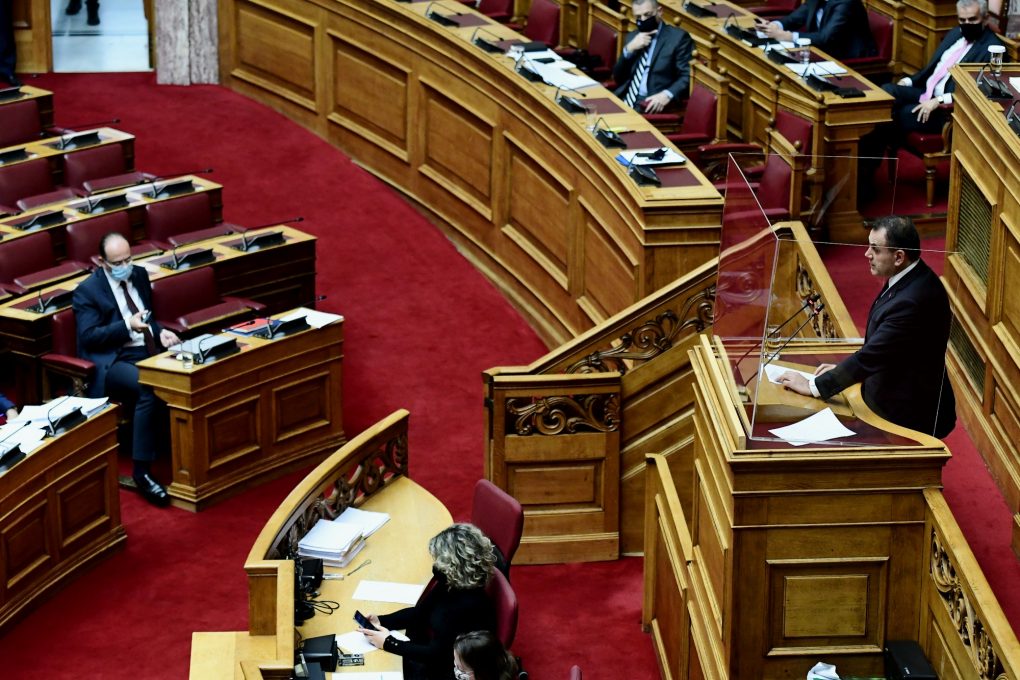
On Thursday, 14 January, the Minister of National Defence, Mr. Nikolaos Panagiotopoulos, stated the following in his first address during the discussion of the Ministry of National Defence Bill “Approval of Draft Contracts in the area of Defence” at the Plenary Session of the Hellenic Parliament:
“Thank you, Mr. Speaker,
to the previous speaker who just left the floor, the President of Greek Solution, I should provide some answers, to the extent possible, because if I have to reply to this barrage of matters raised, I will need too much time. The first I have to say is that he is in too much of a hurry to predetermine the developments, perhaps he anticipates cashing out on the matter in the future claiming ‘I said so, etc., etc.’, but he shouldn’t be so hasty.
Regarding the matters within our jurisdiction, i.e. the Ministry of National Defence, I will say that the useless ‘Mirage’ are not useless, thanks to our intervention they are no longer useless, we resolved this matter with our legislative intervention, which now allowed the uninterrupted inflow of spare parts for the ‘Mirage 2000-5’.
Regarding ELVO, which as you know, following a tendering procedure run by the Ministry of Finance, was sold to an Israeli company, it was not sold with dowry, it was sold, but without any dowry, meaning a previous decision for the future undertaking of the construction of a vehicle. There is no such thing.
Regarding the frigates, I would like to say, as I have said before here, that the game is open. The game meaning the final decision by the Government for the acquisition of four new frigates. And if the Prime Minister or the Government were so tied to German interests, we would simply have chosen the German proposal for the frigate, which is among the many and interesting proposals submitted for the construction of this new ship. There are many and interesting proposals, we are examining them carefully. The decision will not be suggested by ‘Skai’ (I heard that too), but by the Hellenic Navy, to the benefit of National Defence, and the operational capabilities prescribed by the Hellenic Navy, the Staff currently examining the proposal.
Regarding the opening to India, which I believe as a strategic goal of the Hellenic Republic has already been announced by the competent Minister. I should say that the General Director of the General Directorate for Defence Investments and Armaments is here who, a few months ago, visited India to visit a large Defence expo. While there, he met with high-ranking officials of the respective authorities of the Indian Government and the Indian Ministry of Defence. Both myself and the Minister of Foreign Affairs (as far as I know) have met the Indian Ambassador and this initiative is in progress, it just does not progress or rather it does not produce certain results from one day to the next, it takes time, just like the overall multidimensional diplomatic efforts of our country. So let’s be patient. I should say, however, that I am glad because the high tempo at which we run the race, not the arms race, but the great effort to reset the country’s defence, makes the other parties also want to follow suit, making constructive criticism, bringing proposals, a positive stance concerning the voting of bills or subprogrammes examined by the directorate for armaments with legislative initiatives in the form of e.g. modifications, which are beneficial to National interest and contribute to a successful outcome of certain defence-related matters. I should say that this is a pleasant development, but today, within just four months after the beginning of the initial negotiations between the French and the Hellenic side, we bring for voting to the Plenary Session of the Hellenic Parliament the bill on the procurement of the modern ‘Rafale’ aircraft, including their follow-on support and weapons, either through the acquisition of new weapons or through the upgrade and recertification of existing ones, adding weapons to the Hellenic Air Force’s arsenal that can from now on be carried by the ‘Rafale’.
With this landmark procurement, essentially the first major Armaments Programme for many years, we decisively enhance the overall deterrent power of the country’s Armed Forces because the deterrent power of the Armed Forces is none other than the power of their weapons and the quality of their personnel, the men and women of the Armed Forces, and the effort to enhance the overall fighting capability and deterrent power of the Armed Forces is a continuous and intensive effort, literally a National matter, which becomes imperative due to the current geopolitical situation with the multiple and complex security challenges and threats in our broader region. But also due to the political, or rather the overall, behaviour of our neighbour who directly challenges our sovereign rights and threatens peace and stability in the East Mediterranean and seems now willing to participate in dialogue, yet only a few months ago it had caused with its behaviour an unprecedented universal mobilisation of the country’s entire Armed Forces in a situation and a period of escalating tension.
So, within the framework of this effort, in view of the Prime Minister’s proclamations from the Thessaloniki International Fair in September 2020; based on the requirements of the current and the soon to be approved new Force Structure; and based on the overall organised, prioritised, and costed plan for the reinforcement and upgrade of the Armed Forces – with assets and personnel – prepared by the Political and Military Leadership of the Ministry of National Defence and approved by the Prime Minister, we decided the procurement for the Hellenic Air Force of the modern aircraft ‘Rafale’ in the F3R configuration, which is the most advanced for this modern aircraft, it entered production in early 2020, and this is important because, as you understand, this means that the used aircraft we procure are essentially new aircraft. It is an aircraft whose special characteristics and weapons bring clear superiority for the Hellenic Air Force both in the field, the Aegean and the East Mediterranean, as well as in terms of overall air power balance between Greece and Turkey.
During the discussions at Parliamentary level during the Armaments Committee session of 17 December 2020, during which we had a first, yet very important and in–depth briefing, I believe, until the sessions of the Committee for Foreign Affairs and Defence during the past two days, very intensive and helpful, covering a broad range of matters concerning the technical and other points of the contracts that comprise the bill at hand, we fully explained all the technical characteristics of this platform and its weapons.
It is not the place for more detail, nor the time. So we proceeded to this procurement at great and unusual, I would say, speed for Greece. We had to respond to the need and I think we did so in the best possible way. The negotiations were intensive, complex, and pretty difficult, but were essentially completed in three months, thanks to the hard work of all the Ministry officials involved, the Hellenic National Defence General Staff and the Hellenic Air Force General Staff, the General Directorate for Defence Investments and Armaments, of course, which played a major role in the negotiations through the working group headed by its General Director, the General Directorate of Financial Planning and Support that adapted the procurement to fiscal reality and enabled both the disbursement and securing of the relevant amount, as well as its inclusion in the increased 2021 Defence Budget. And, of course, thanks to the very good, extremely constructive spirit of the French side, both at political leadership level due to the excellent direct relationship between President Macron with the Greek Prime Minister and the constructive and truly excellent relationship between myself and my French counterpart, as well as at the level of service officials, in particular at the Hellenic – French Air Force level, the cooperation was excellent and this brought positive results within a short time on such complex matters, because a contract, which is essentially three contracts for the procurement of the aircraft, the follow–on support, and their weapons, given also the fact that some of those aircraft were used, thus raising many and difficult issues concerning the selection of the best used aircraft or, in any case, aircraft which are in very good condition, something that the French side provided, proposing solutions which were eventually fully accepted by the Hellenic Air Force.
We had this result and, for that to happen, we had to combine speed, flexibility, effectiveness, as well as, of course, transparency. We chose the negotiation procedure without a tender notice, a certainly legal procedure due to the emergency situations due to the crisis. And, today, we bring for voting to Parliament this bill, which constitutes the special Regulatory Framework governing this procurement.
Immediately after being voted, the bill will be sent to the Court of Auditors for pre–contractual audit in order to ensure the conditions of legality and transparency by a judicial, hence independent, authority. To this end, through negotiations with the French manufacturers on the terms of cooperation, three draft contracts were prepared which are today submitted for discussion:
-
The first draft contract is between the Ministry of National Defence and the manufacturer ‘Dassault’ for the procurement of six (6) new and twelve (12) used ‘Rafale’ aircraft with relevant equipment and services for their initial support.
-
The second draft contract is for the follow-on support of the ‘Rafale’ aircraft concluded between the Ministry of National Defence and the three manufacturers ‘Dassault’, ‘Thales’, and ‘Safran’. For as long as we are the Political Leadership of the Ministry of National Defence, you will never see again in this hall a contract for the procurement of an asset, particularly an air asset, without a follow-on support contract, as was the case in the past.
-
The second draft contract is for the procurement of equipment, i.e. weapons, for the ‘Rafale’ aircraft, as well as the maintenance and modification of existing ‘Mirage 2000-5’ weapons to be used by the ‘Rafale’. During the negotiations, it was discovered that there are requirements by the three companies on separate matters that can only be met by special regulatory framework, since there were deviations from applicable law governing the implementation of Defence procurement contracts.
Deviations were discovered, these issues were of course addressed by means of special regulations concerning the letters of guarantee to be submitted, the procedure for the acceptance of the contractual articles, the consequences in case of late delivery of the contractual object and specifically the penalties, liability against third parties, payment terms, and the terms of contractual dispute settlement through arbitration.
Seven points which were all addressed through negotiation, some terms of the other side were accepted by us, some of our terms were accepted by the other side, some were rejected, some were accepted as a whole. This is the point of a negotiation, in order to protect public interest and proceed quickly, without forfeiting the limits we clearly defined from the beginning, we accepted these minimal deviations from applicable law or rather the introduction of special regulations which are mainly technical and concern the implementation of the contracts. It is self-evident that these terms included using special regulations in the bill at hand do not deviate from EU law.
The companies with whom we will conclude these contracts are, as you know, the single manufacturers of the systems whose manufacture or support they will undertake. So, it is clear that it was not possible to conclude any contract with other companies, at least at the initial procurement stage.
Regarding the involvement of the Domestic Defence Industry, which is very reasonable and we all want it to happen, I think it is possible both by law and by the provisions of the contracts to happen in the future, but not during the initial procurement stage, since the procurement is concluded with a single manufacturer, as I said. Without these special provisions, we would not have succeeded in the cooperation for the procurement and follow-on support of the ‘Rafale’ aircraft. Regarding the approval of the contracts by law prior to being signed, I should clarify the following:
Given the incompatibilities and the discrepancies of certain contractual terms from the applicable legal framework, it would not be legally permissible for these draft contracts to be signed and then ratified, in order to strengthen their terms. Which is reasonable, since applicable law would not allow their conclusion and subsequent implementation, in particular given the fact that the implementation of the contracts would start immediately.
Furthermore, it is obvious that the Court of Auditors would not provide permission to sign these drafts during the pre-contractual audit. At the same time, we must accept that the pre-contractual audit by the Court of Auditors essentially provides the conditions we set, all the guarantees for transparency and legality of these contracts. So, the legislative strengthening of these contractual terms that deviate from applicable law can only be allowed by law, the one at hand, through which the National Assembly will approve the draft contracts and authorise the competent authorities to proceed to their conclusion. It is stressed that this has happened in many cases in the past.
As we have said during the Committee session, in order to ensure confidentiality of parts of the contracts, which however were available and accessible to the party representatives for several days for their information, let’s not forget that, the originals of the approved draft contracts are kept by the GDDIA. These texts include a lot of confidential information related to the organisation, structure, supply, and equipment of the Armed Forces. Their publication would damage the country’s Defence and Security. Additionally, they include information in the form of technical details, specifications, designs, etc. related to industrial confidentiality of the contracting companies, which as single manufacturers requested of course that they not be disclosed in order to protect their legal interests. It’s a standard practice in these cases, we also went through this in late 2019, when we came to ratify the framework agreement for the follow–on support of the ‘Mirage 2000-5’ mentioned earlier.
So, for all these matters, for two days we provided extensive clarifications, answered all questions, provided explanations on all relevant reservations, even on confidential information which, as I said, was accessible and available to party representatives during this whole time. It was proved following complex negotiations, under difficult conditions, because during a pandemic, contacts between the delegations, at least physical contacts, were not easy, and this certainly delayed the procedure somewhat, if one can talk of delays when such a contract is introduced to Parliament for voting only four months after the beginning of the negotiations. I think we can all agree that this has never happened before, at least in Greece, and I don’t know if it is ordinary for Defence procurements globally. So, we had the best results in terms of National interest.
Ladies and Gentlemen, Members of Parliament,
I think 2020 was a very good year in terms of rearming the Armed Forces and especially the Hellenic Air Force. As I said, it started with the supply of spare parts for the ‘Mirage 2000-5’ after the approval by the Court of Auditors of the implementing contracts of the framework agreement for their follow-on support introduced and voted in December 2019.
We actually launched the four F-16 aircraft upgrade programme to the ‘Viper’ configuration, the most advanced version of this aircraft in the world today. The relevant decision had been made by the Hellenic Air Force, but it had not yet been implemented. The implementation started with the voting of the relevant law in December 2019 and is currently in progress. It is not enough to make the decision to start the implementation.
Furthermore, the Armaments Committee of the Parliament approved the two follow-on support subprogrammes for the Hellenic Air Force’s transport aircraft fleet, which was left grounded for many years. Their maintenance and the return of several of them to flying condition, thus becoming available to the Hellenic Air Force, is well underway, I am talking about the C-130 and C-27.
The establishment of an International Flight Training Centre in Kalamata has been arranged, within the framework of the Strategic Agreement with Israel, in order to fully meet our cadets’ training needs, as well as attract trainees from third countries, thus generating revenue for the Greek economy.
A lot has been done, ladies and gentlemen. Not everything, but the effort continues. It continues in a spirit of excellent cooperation between the Political and the Military leadership of the Ministry of National Defence, with hard work, with a plan, with faith in the National necessity of this effort.
And now, the ‘Rafale’. In less than a year after the beginning of the negotiations, the first Greek ‘Rafale’ will land in Tanagra, this landmark and historical Unit that operates the Hellenic Air Force’s ‘Mirage’ aircraft which now, more than ever after several difficult years, goes through a period of euphoria, anticipation, and raised morale of the personnel.
Starting this summer and for the next two years, 18 supersonic ‘wind gusts’ (this is how the ‘Rafale’ is translated), with Greek roundels and flown by Greek pilots, will come and fly across our National Airspace, in the East Mediterranean, and together with the rest of the Hellenic Air Force’s fighter fleer will cover even more effectively the Aegean with their wings and their weapons.
So today we pave this road. I am asking all parties to joins us in this great effort to enhance the country’s defence capacity by supporting this bill for the procurement of the ‘Rafale’ and its weapons.
I know, ladies and gentlemen of the opposition, that this is what you all want. But you must also confirm it through your vote and I am truly glad that the largest opposition party will support it, despite your reservations. I should remind you that you reserve the right to monitor, as you should, the good implementation of the contracts in the future and I prompt you to do it to see how they will develop. Supporting this bill today does not deprive you of this right.
Regarding the modification submitted by KINAL, I think at least the second paragraph should be accepted on the periodic evaluation by the Armaments Committee of the good implementation of the contract. This can also be included in the text.
Regarding the need or the possibility of involvement of the domestic Defence Industry, I think this is provided, if you look at the contract, but we will see that in the future when there will be needs for maintenance of these aircraft, on condition that the HAI can operate in the way we would all want in order to have the available workload for the ‘Rafale‘.
But today I will prompt you to do something else. Not to check the contract for the future, but to support this bill so that we can all with a sense of patriotic responsibility, political maturity, and bipartisanship, send from here, the Plenary Session of the Hellenic Parliament, a strong message in all directions that Greece is determined to do whatever it takes to protect its sovereign rights, to deal with any security challenge and threat in the broader region using its even stronger and more deterrent Armed Forces.
Thank you”.