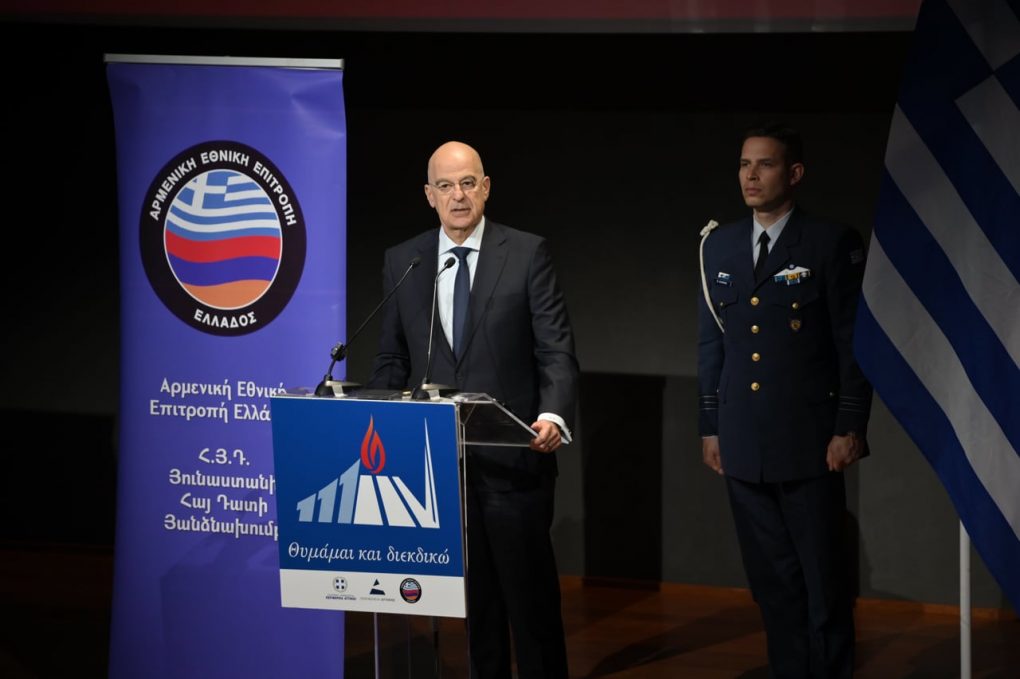
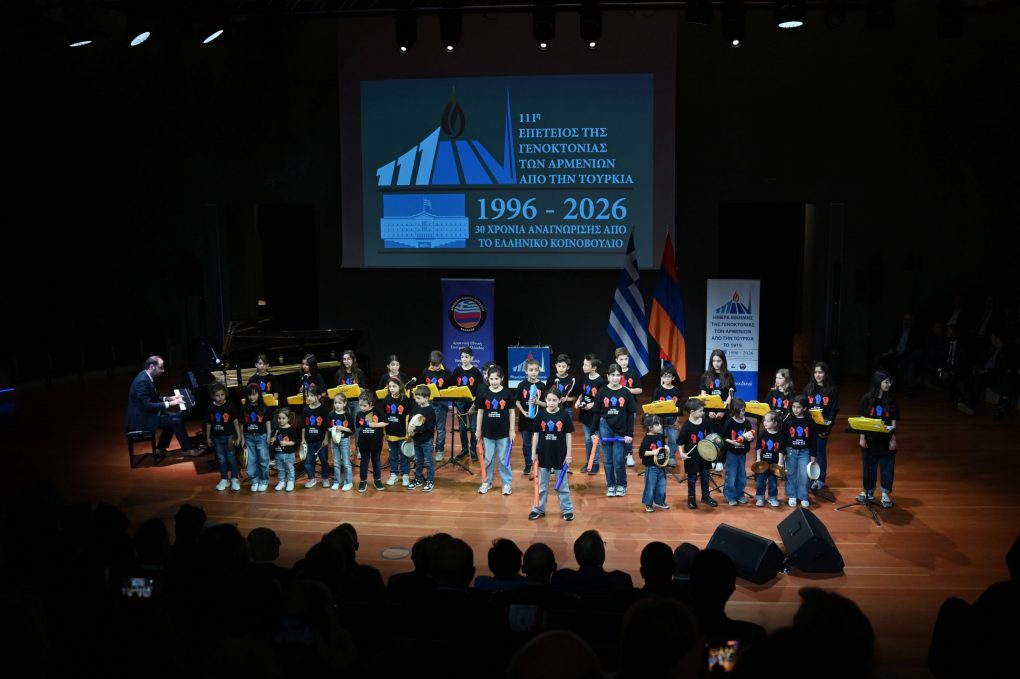
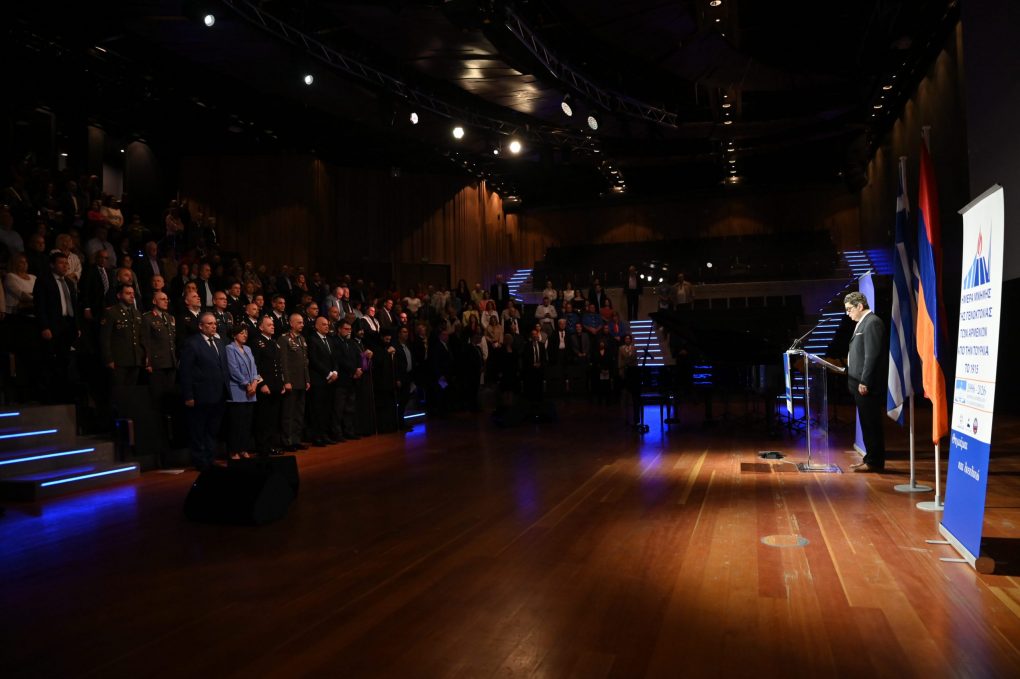
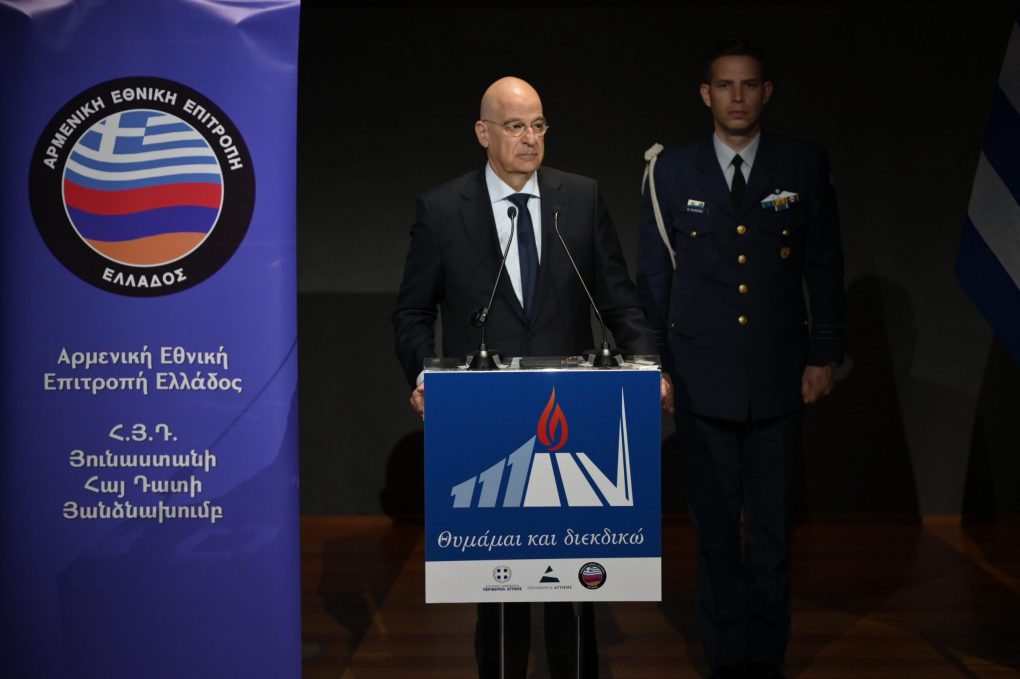
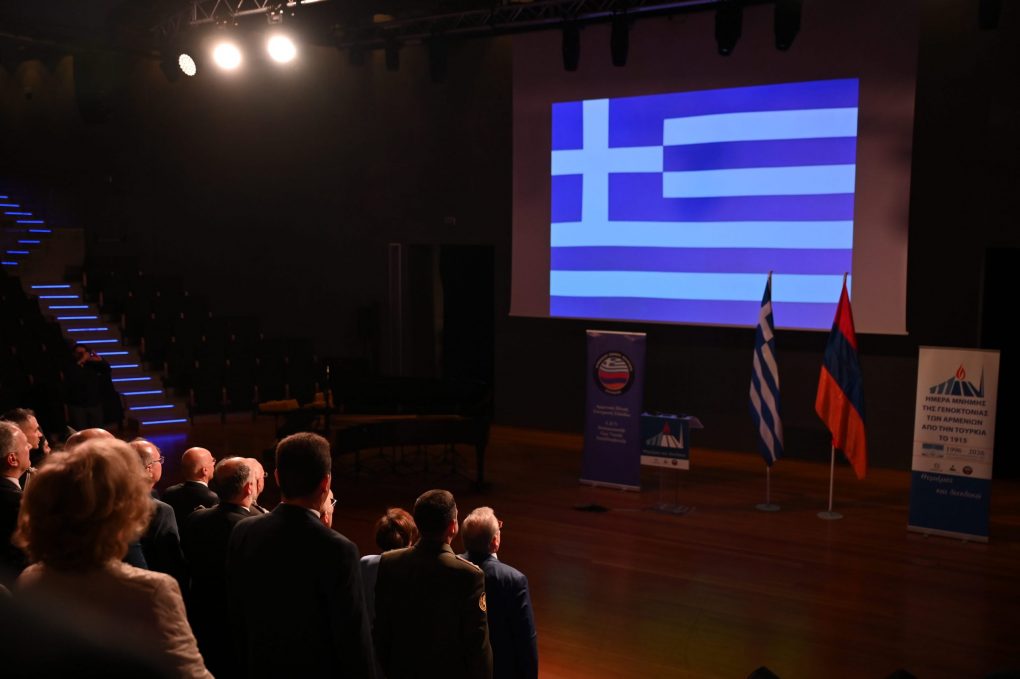
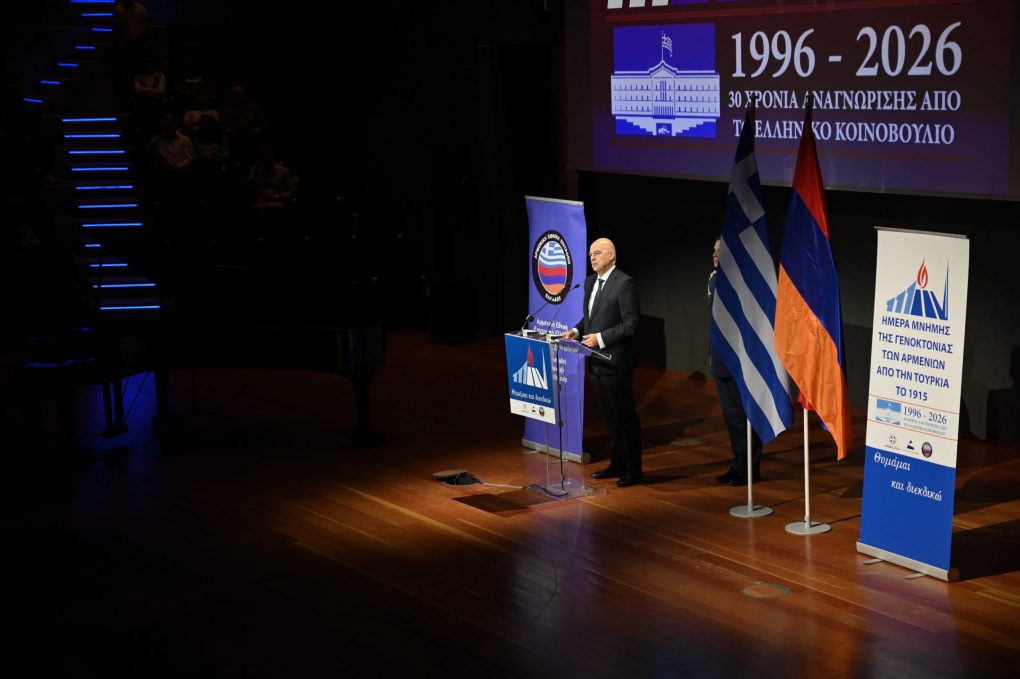
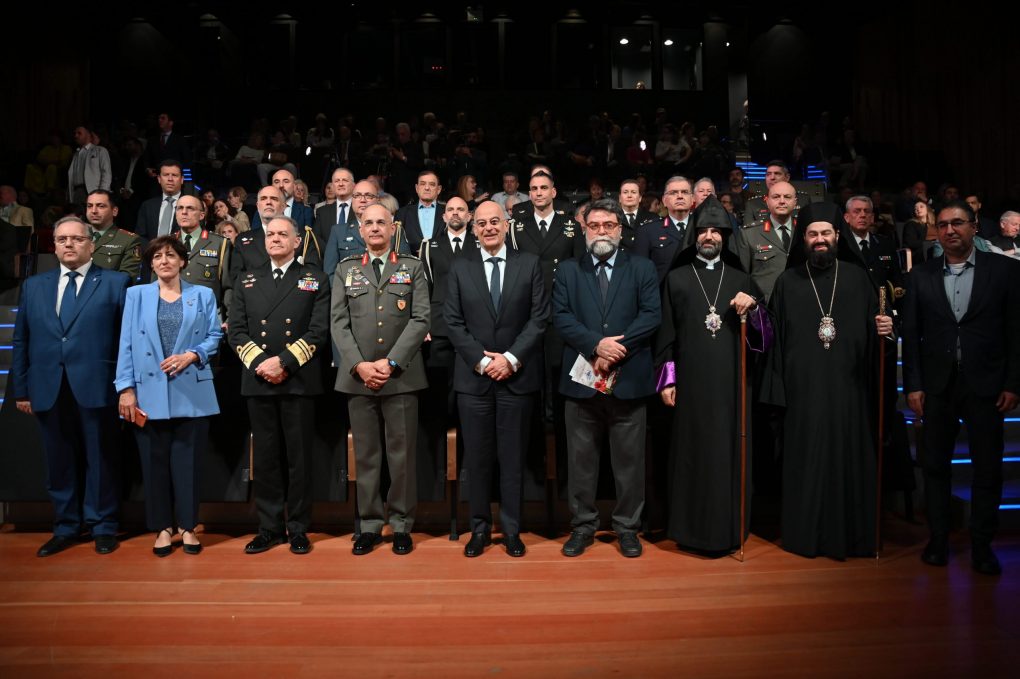
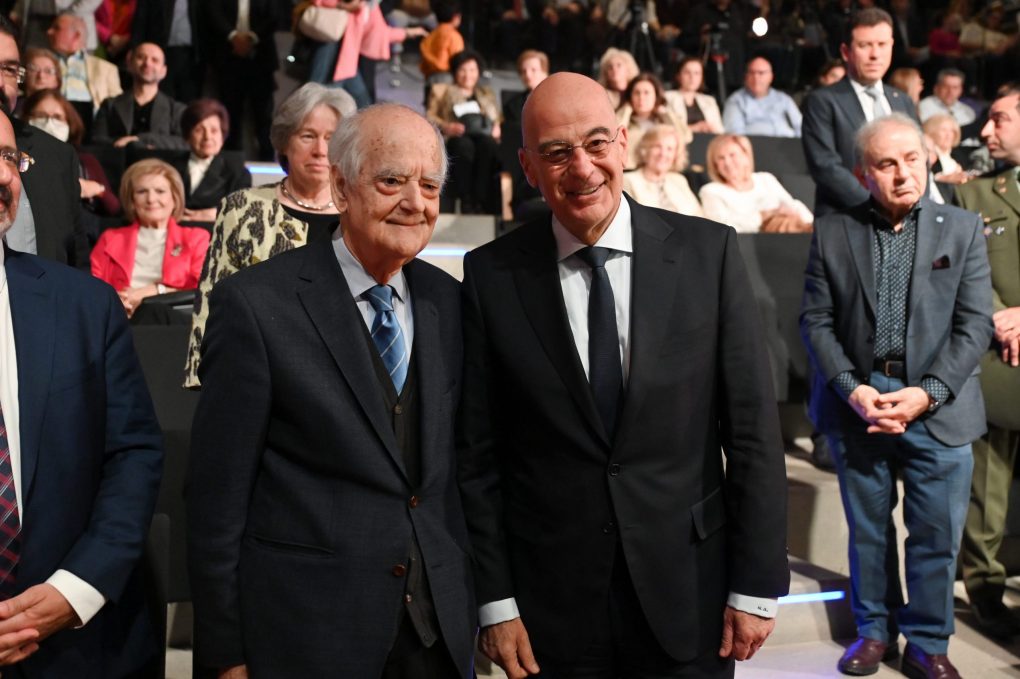
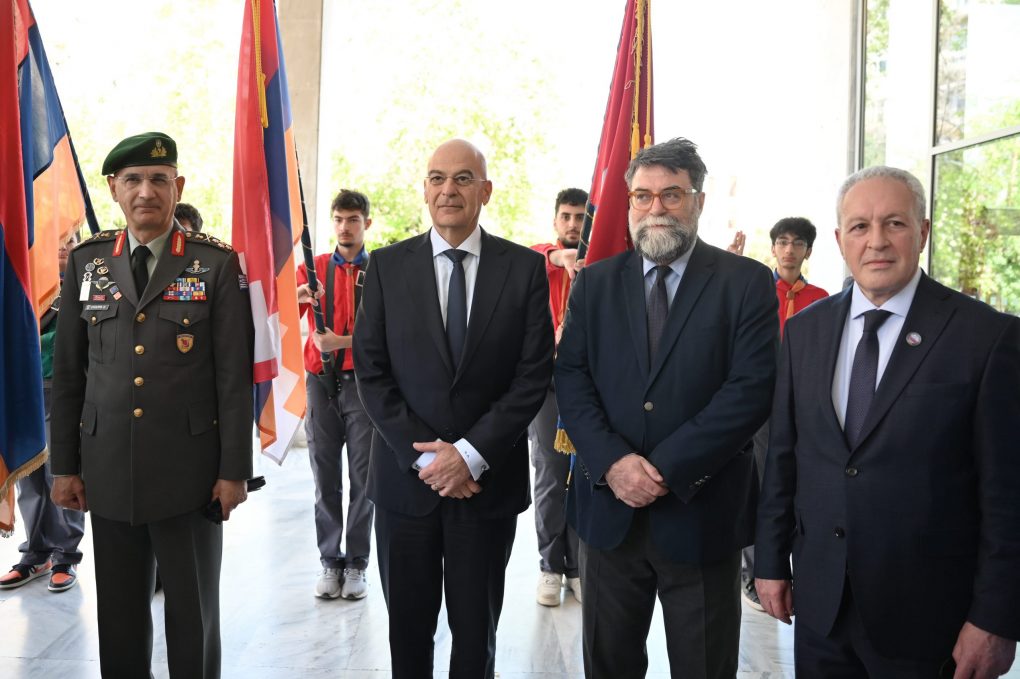
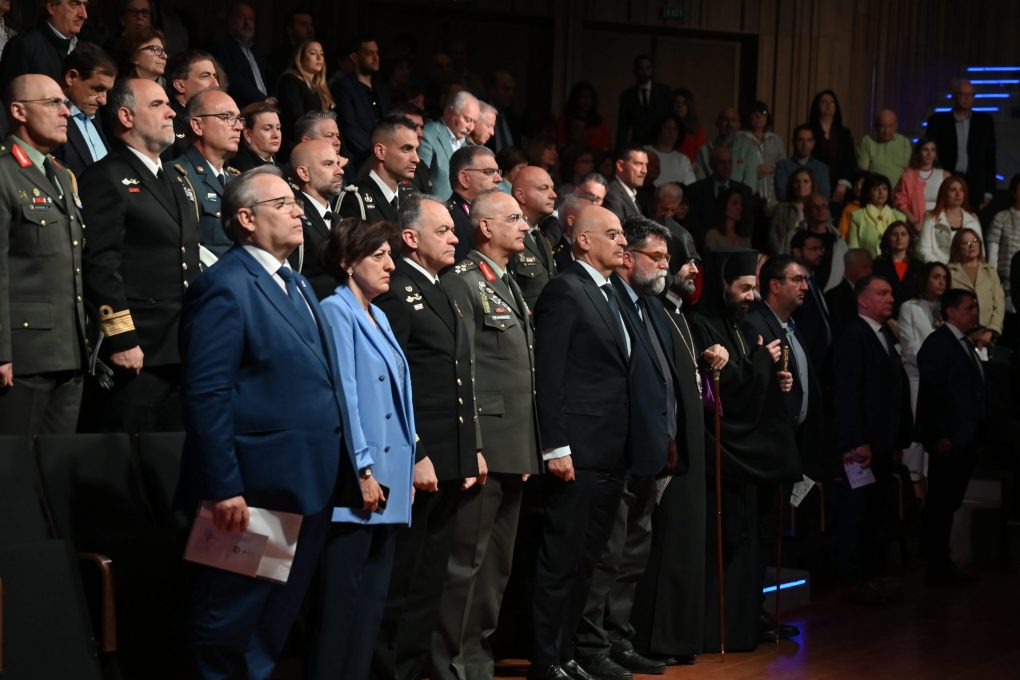
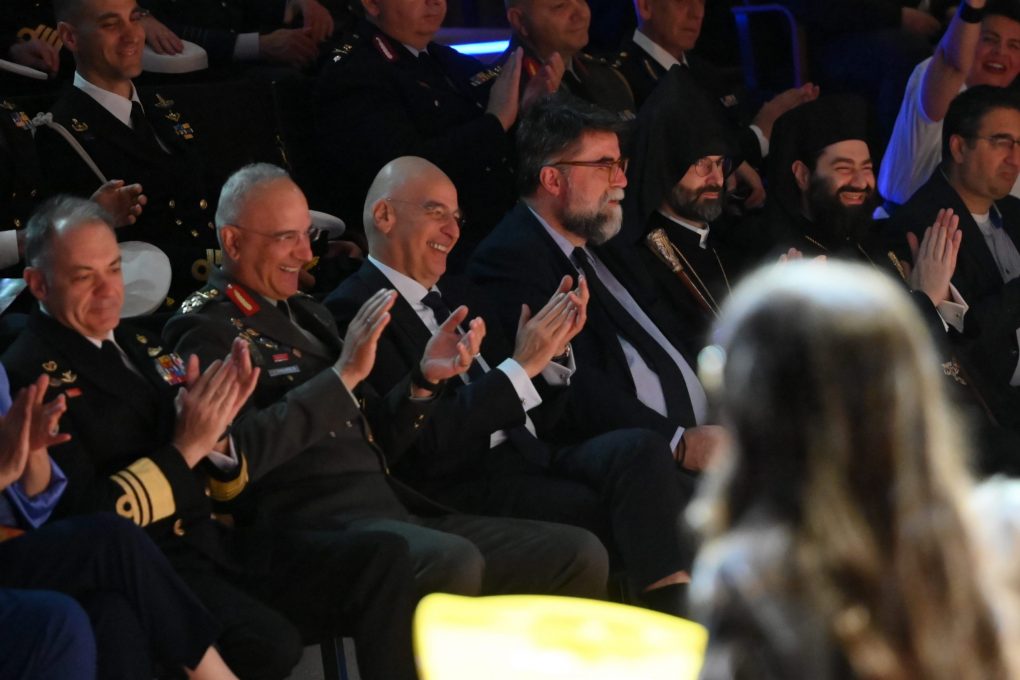
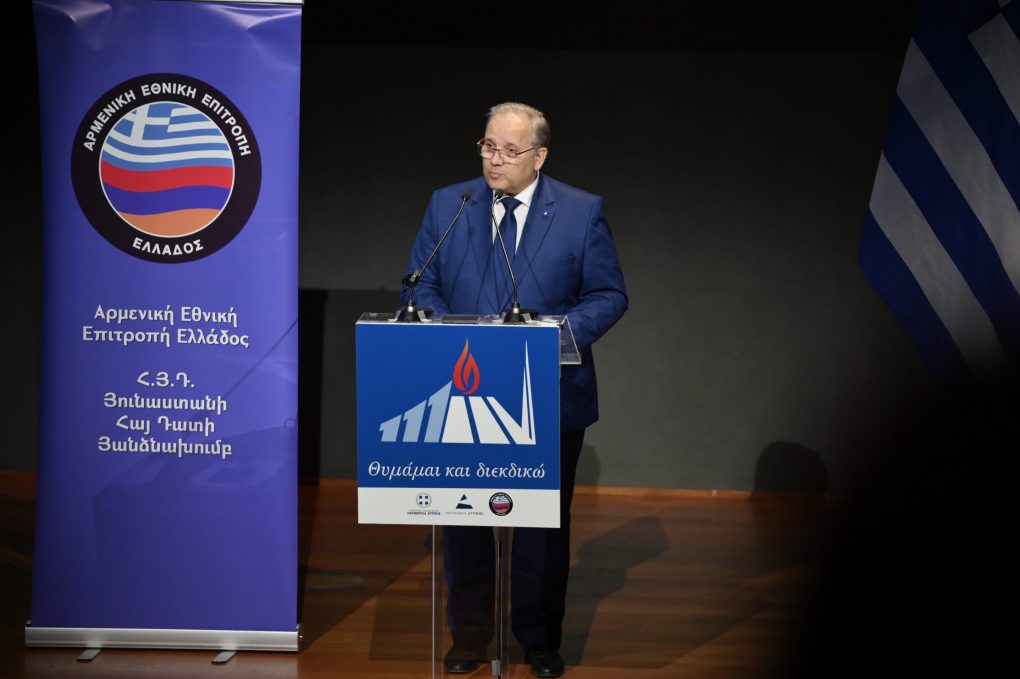
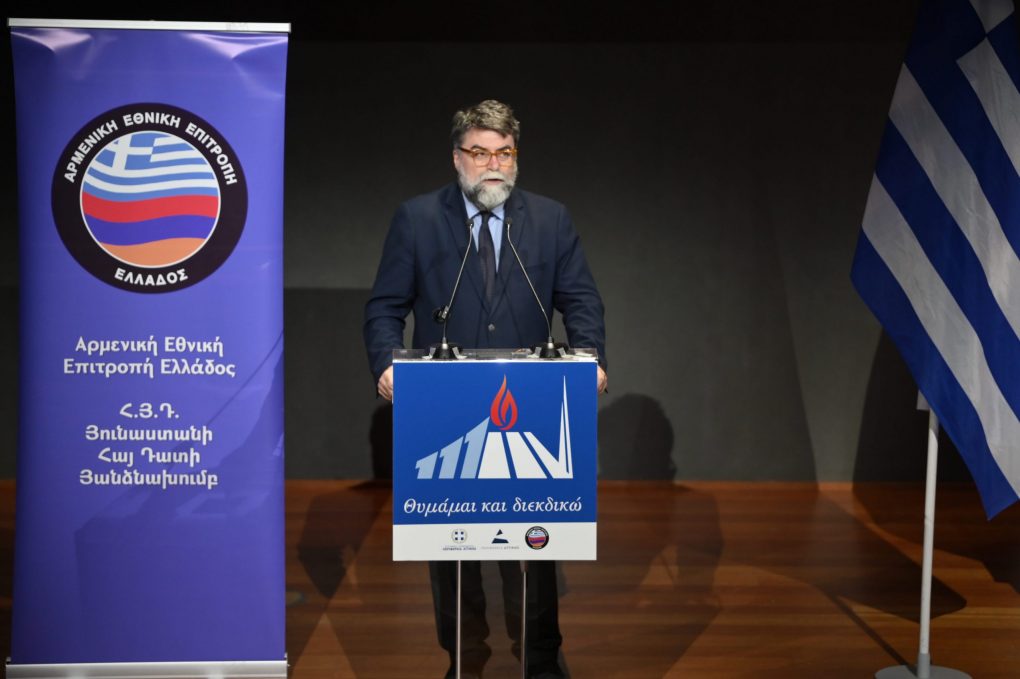
The Minister of National Defence, Nikos Dendias represented today, Sunday 26 April 2026, the Prime Minister and was central speaker at the event for the “Remembrance Day of the Armenian Genocide by Turkey”. The event took place at the Athens Conservatoire, under the auspices of the Armenian National Committee of Greece, in cooperation with the Region of Attica, on the occasion of the 111 th anniversary of the Armenian Genocide, and the 30 years since its recognition by the Hellenic Parliament.
Mr. Dendias stated in his address:
“Ladies and Gentlemen,
It is a great honour and responsibility to be present at today’s event on this podium, representing the Hellenic Government on an Anniversary, which we do not solely consider another temporal landmark in the long catalogue of anniversaries.
But it is a date which belongs to the collective memory of each human who wishes to feel human, who honours his kind, and shares the opinion that we differ from the animal kingdom, and through a millennia long process of evolution, have left the law of the “jungle” behind us.
Thus, for this reason, 111 years after the 24 th of April 1915, we commemorate the day when the Leadership of the Young Turks, in the name of national purity and homogeneity, which they were seeking to create, ignored, disdained, and violated every humanitarian principle, and initiated the systematic – I repeat systematic – annihilation of the Armenian people. Starting with the leaders of the Armenian nation, arresting hundreds of intellectuals, clergymen, and notables of the Armenian community in Constantinople.
In the name of restoring historical veracity, I would like to state that the tradition of genocides had begun a few years earlier. It is not known, since it occurred in Africa by a German officer, von Trotha, when around 100,000 native Namibians perished.
Yet, in the sad case of the Armenian Genocide, there were also German officers present. It is certain that the by then main German advisor to the Turkish General Staff, von Schellendorf, was aware of, and had accepted the Armenian genocide. As you also know, I often ask my German friends to name me four important Ottoman field Commanders in World War One. I already named the first.
The other three are von der Goltz, who in the latter phase trained the Ottoman Army, Liman von Sanders, commanding the field army in Gallipoli, and von Falkenhayn, in charge of the southern Turkish Army.
Yet modern Germany has, and we ought to point it out, recognised the Armenian genocide, expressing thus, albeit belatedly, remorse for the acts that the officials of the Kaiser’s Empire tolerated, if not the ones in which they participated.
The sole historical fact, however, which remains undisputed, completely proven, despite what anyone says, is the genocide itself, the death marches, the massacres, the uprooting from the ancestral hearths.
All this, I must reiterate, since it must be said, is not an act of blind violence, not that that would not have been absolutely condemned, but a fully organised and thought through state plan. Which is what modern science recognises as and determines to be genocide.
Thus we witnessed how a patriotic movement, following the general principles of romanticism, aiming to form a national state, transformed, in the latter phases of the Ottoman Empire, in the hands of the Young Turks, not into a positive narrative for forming a modern nation – state, but a violent, sinister, hideous narrative of national cleansing.
Today we honour one of the most important victims of this sad national cleansing, the Armenian people. A people with a long history, a spiritual and cultural legacy. A people who embraced Christianity as an official religion, with their own special language – we heard it previously – with an alphabet possessing a resilient and important identity, and a people who has marched at the side of us Greeks, throughout time.
With a people, – who I want to say has certainly not forgotten – since, I think all in this hall are aware that the Armenian people executed the leaders of the Young Turks, Talaat, Cemal, Şakir, Enver, the worst case of all as a military leader, who was killed in modern day Tajikistan.
The Armenians, however, did not forget. In Greece, we, following the genocide, following the Asia Minor Disaster, welcomed tens of thousands of our Armenian brothers, refugees uprooted from their ancestral hearths. Who also faced the persecutions faced by the Asia Minor Greeks.
I think it is very significant, that the Armenian community in Greece has grown, flourished, distinguished itself, made contributions, lives with us and marches by our side, to a European future for Greece, which we wish for, and support our friendly Armenia’s sharing thereof.
I would like to commemorate, as a tribute of honour to the Speaker of Parliament Apostolos Kaklamanis, the fact that it was in his days that the Hellenic Parliament recognised and established 24 April, which we honour today, as the Remembrance Day of the Armenian Genocide.
Which also constitutes an act of justice, a principled act, an act of dignity, of respect to the dead. An act of truth.
For as you know, the Greek language is an important language. It is an important language, since it independently sets forth a cultural proposition. I’ll explain myself: Truth in Greek is the negation of forgetfulness. The negation of obscurity. Something quite different from what applies in other languages. For example, in Latin, the fount of all languages of the Western World, truth, named veritas, derives from the Indo-european root ver, which means being, the real.
In German for example it is Wahrheit, the real. For us however it is not solely reality. It is the ever existing, that which we forget not. And for this very reason the recognition of the genocide is an act of truth.
Many decades have gone by, many years. Yet, as I said, we have frankly not forgotten. I am sorry to say that mankind has not learned its lesson from the Armenian genocide. Others followed, the Holocaust of the Jews in World War Two, and more recently, unfortunately, the genocide in Rwanda. But the fact that the Armenian genocide was not condemned in time allowed this miserable continuation.
Today we stand at the side of the Armenian people. We stand at the side of Armenia, with respect, solidarity, historical conscience, with a feeling of responsibility. We render a tribute of respect and honour to those that lost their lives then, to their living descendants today, to the resilience of the Armenian people who did not submit, did not disappear, and created a modern state.
I will repeat the self-evident, that Greece stands, and will ever stand at the side of Armenia. With a feeling of responsibility towards its own history.
Thank you very much”.
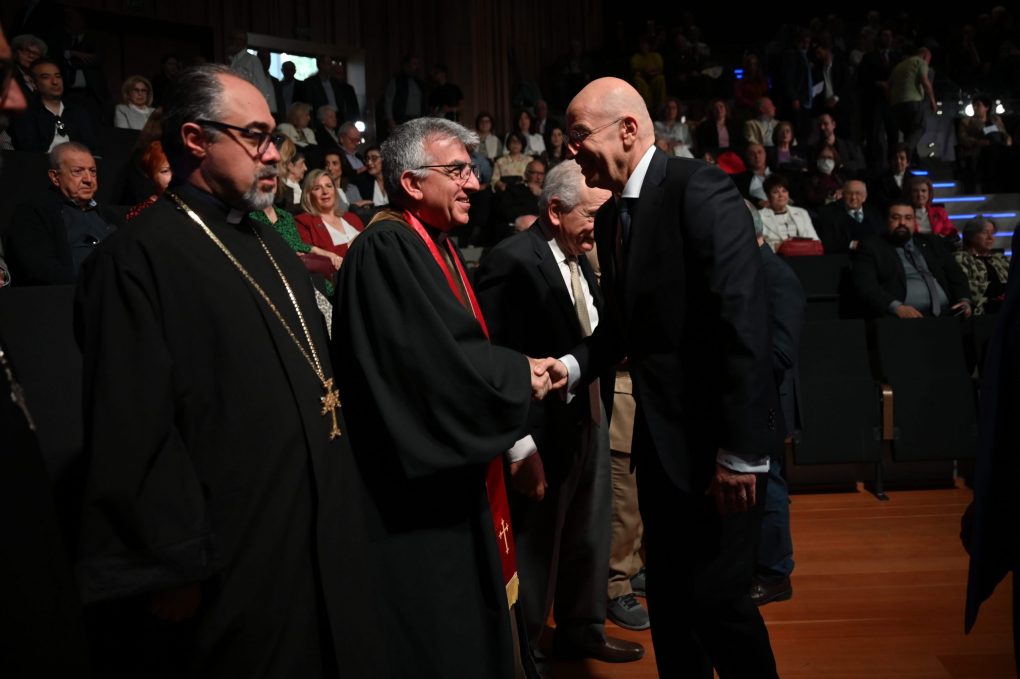
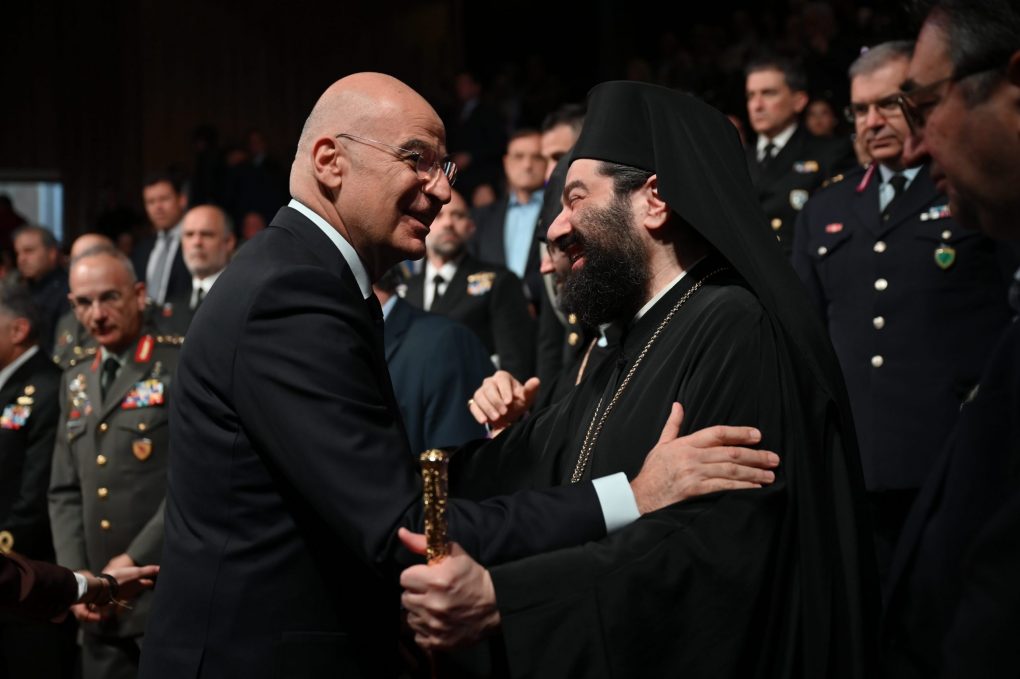
The event was also attended by the Chairman of the Parliamentary Greece- Armenia Friendship Group, MP Vasilis Oikonomou, as representative of the Hellenic Parliament, the Former Speaker of the Hellenic Parliament, Apostolos Kaklamanis, the MPs Pavlos Christidis, Katerina Notopoulou, Stylianos Fotopoulos, Athina Linou, Athanasios Chalkias, the Chief HNDGS, General Dimitrios Choupis, the Chief HNGS, Vice Admiral Dimitrios – Eleftherios Kataras HN, the Bishop of Evripos, Mr. Chrysostomos, as representative of the Archbishop of Athens, the Deputy Head of Region for the Central Sector of the Region of Attica Georgios Vlachos, as representative of the Head of Region for Attica, the Deputy Head of Region for the Western Sector of Athens, of the Region of Attica, Alexandratos Charalambos, the Mayor of Nea Smyrni Georgios Koutelakis, the Mayor of Distomo – Arachova – Antikyra, Ioannis Stathas, representatives of Parties and Municipalities, heads of diplomatic legations to Greece, general and senior officers of the Armed Forces, representatives of the Security Forces, of entities, federations, associations, as well as of the Armenian Community of Greece.
Also in attendance were His Eminence the Metropolitan Bishop of the Orthodox Armenians of Greece, Mr. Sahag Yemishyan, the Ordinary for the Catholics of the Armenian Rite in Greece, Mr. Mikael Bassalé, the Pastor for the Evangelical Armenians of Greece, Mr. Vigen Tsolakian.
Addresses were made by the representative of the Hellenic Parliament, Chairman of the Parliamentary Greece-Armenia Friendship Group, MP Vasilis Oikonomou, the representative of the Head of Region of Attica, Georgios Vlachos, and on behalf of the Armenian Youth of Greece, by Armen Tsakalian. Also, a recorded address by former Prime Minister Antonios Samaras was played.